


The Enabling Context
The ENABLING CONTEXT is the supportive policy and organisational context in which the change is taking place. It is about ensuring the conditions are in place that can sustain the innovation over the long term. It involves:
- Readiness – understanding how ready people and organisations are for the change and creating commitment to support the change.
- Alignment – creating alignment across efforts so that they pull in the same direction, rather than compete with one another.
- Capacity – building local implementation teams, competent and confident to drive the change.
- Learning and informed decision making – supporting learning and creating feedback loops between children, families, community, practitioners and senior leaders to understand the consequences of change, barriers and what helps, and inform timely decisions.
Where the environment and conditions are right, a programme prospers and grows. If a change occurs in a context that is not adapted to support it, then it risks being altered and losing its effectiveness. In this section, we look at the supportive environment and conditions that were needed in the ANEW programme, including paying attention to readiness and capacity for change across all levels of the children’s services system, and building a cascading model of support.
Attending to readiness and capacity for change
Supporting change requires paying attention to the variations in the supportive environment at all times and across all levels of the children’s services system.
Beginning with the strategic level, the choice of Dundee as a site for the ANEW programme considered the readiness and capacity for change among the Dundee Community Planning Partnership. This was discussed and appraised by members of the Dundee Partnership and CELCIS, who collectively agreed that the following essential conditions for ANEW could be met:
- Local prioritisation of addressing neglect and enhancing wellbeing;
- A history of multi‑agency collaboration in children’s services;
- Committed leadership and willingness to resource an implementation team;
- Willingness to engage in programme learning.
Having effective communication with senior leaders was seen as essential for maintaining a supportive environment for the programme. ‘Feedback loop’ meetings were scheduled between senior leaders and the team implementing the programme, to have open, two-way discussions on what was working well and what was getting in the way, to agree the best actions to support progress. We learnt that if these scheduled meetings were not going ahead as often as needed, we would then view this as an important indicator that the conditions have shifted.
Similarly, at the outset of working at site level – whether with a school, nursery or health visiting team – we supported open discussions to mutually understand if it was the right time for them to join the ANEW programme. Then, where a site joined, we learnt not to overlook when the practice changes were only partially tested or used, and to look more closely at the conditions that supported or hindered their use. We found that initial site commitment and enthusiasm to the ANEW programme can fluctuate, particularly when key staff change. This confirms the value of having regular meetings with each site to understand and respond promptly to any changes, and support colleagues to feel ready to (continue to) take part in the programme.
We also cannot overlook the wider challenges that can affect a programme. The COVID-19 pandemic was an extreme example of where conditions changed but more common challenges that affected the pace of the ANEW work were: external inspections; organisational restructures and annual budgetary planning; and the turnover or absence of key leaders and staff, which (temporarily) diminished understanding of and commitment for the programme.
Overall, the conditions for change fluctuated during the ANEW programme, as competing needs and priorities came to bear. This taught us to expect ebbs and flows in the supportive environment, particularly when the change efforts are complex and long-term. We learnt that where the conditions for change are no longer in place, the work might need to be paused or even stopped, and attention refocused towards understanding how to strengthen the Enabling Context.
Building a cascading model of support
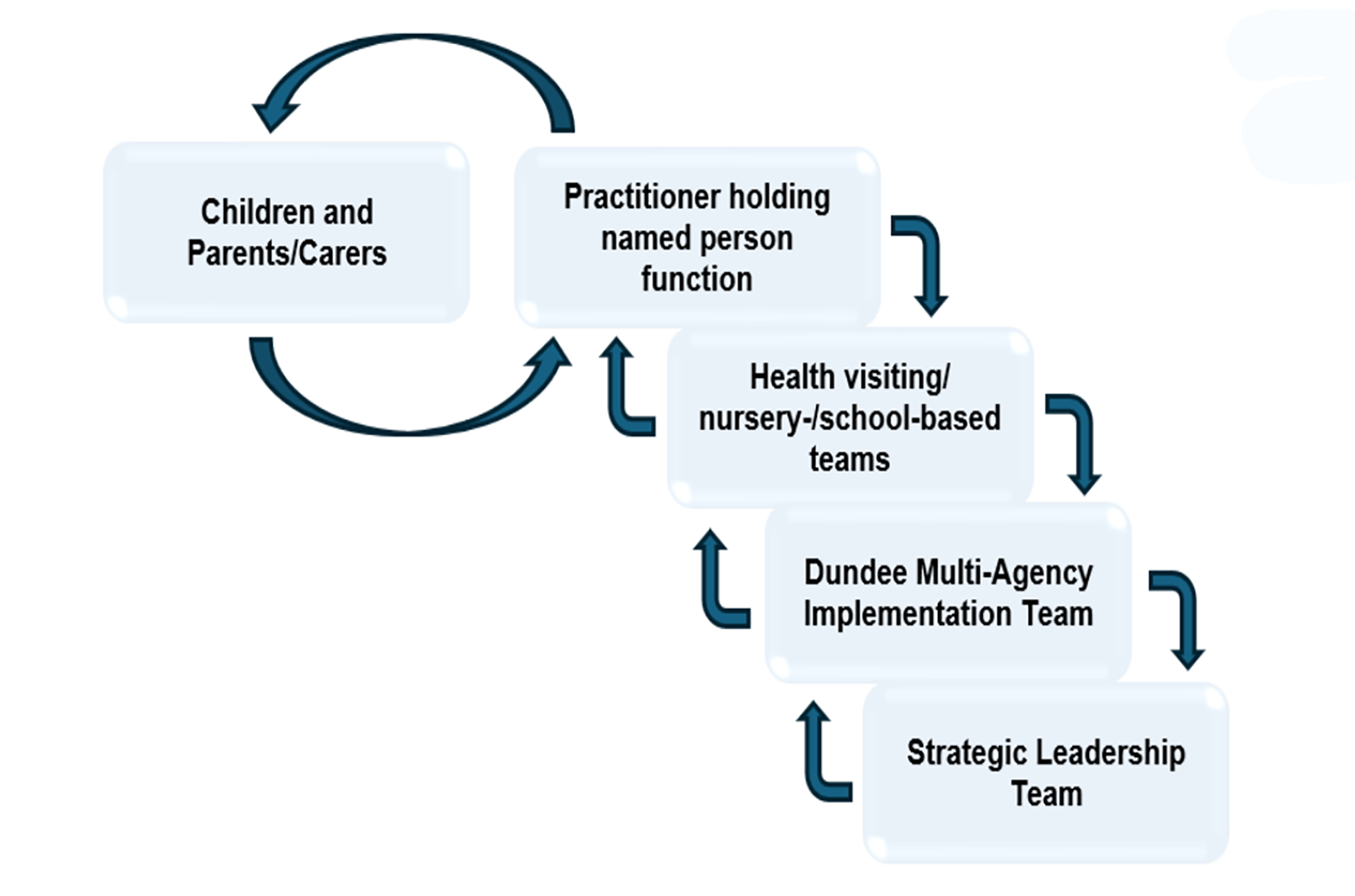
The evidence states that change does not just happen, nor can it be brought about by one person alone. Change requires a model of support formed through cascading implementation teams, committed managers and practitioners, and good communication and partnership at all levels.
In the ANEW programme, the cascading model of support involved frontline practitioners and managers in each site, local implementation team, senior leaders and external expertise.
Establishing a local, multi-agency implementation team
To hold and drive forward the ANEW programme, a local, multi-agency implementation team was established at the outset and has been a constant throughout. While its membership changed over the course of the programme (as people inevitably moved jobs), the Dundee Implementation Team consistently had three to five members spanning Dundee’s social work, education and health visiting workforces.
The Dundee Implementation Team met regularly – typically on a fortnightly basis – to review programme activity and data, respond to emerging issues, align efforts and plan ahead. Between meetings, members of the team worked closely with individual sites to support practice change within health visiting teams, nurseries and schools. The team also engaged with Dundee’s senior leaders to share learning and highlight challenging issues where strategic input was needed.
“CELCIS has really helped, as had we not had this approach and evidence behind us, I think we would have just gone into another silo. At the heart of this [ANEW work] is partnership working, which is also complex and requires tricky conversations, so we are working within both silos and partnerships, helping people to see and model how this can be moved forward. This is probably the most crucial element to the success of this work.”
Local Implementation Team member
Kirsten Jorna, Dundee Council, talks about being part of the implementation team
Establishing site implementation teams
Each nursery and school involved in the ANEW programme established a site implementation team composed of those with the named person function and other practitioners in the Meeting Buddy role, supporting the voice of children or parents/cares.
Within the Dundee Health Visiting service, the site implementation team was formed on geographical basis and included all health visitors in the east of the city, and their managers. The team also created the role of the ANEW Champion, who supported colleagues in the Health Visiting service to use the ANEW practice changes.
Effective leadership in individual sites proved to be key in sustaining the new practices, and in fostering the values and principles of the approach across their setting.
Support from senior leaders
In order to flourish, implementation teams need support. Senior leaders provided this by engaging in conversations with the implementation team, discussing learning and feedback from children, young people and their families, and practitioners, thus ensuring that a ‘feedback loop’ was in place.
By ringfencing time for the implementation team members to progress the work and giving the team permission and resources to try new and different things, leaders at strategic and site levels removed barriers and enabled change.
Audrey May, Executive Director of Children and Families Service, Dundee City Council discusses working with CELCIS
Support from CELCIS
CELCIS supported the implementation teams by providing training and coaching on using implementation science, supporting the development of practice and data tools, and offering time and space to jointly reflect on programme activity and plan ahead. We supported people to share and consider diverse opinions, and we were well placed to constructively challenge and disrupt assumptions, mindsets and approaches proven ineffective by evidence.
Recognising the complexity of the ANEW programme, CELCIS formed a team that was multi-disciplinary, with roles spanning across implementation consultancy, children's services planning and delivery (including allied health disciplines), data and research.
Developing the ANEW Community of Practice
A Community of Practice was formed by regularly bringing together the teams from all three local areas involved in the ANEW programme, the CELCIS team and the Scottish Government. As convenor of the ANEW Community of Practice, CELCIS facilitated collective reflection, captured the learning, and strengthened local teams’ knowledge and skills to use Active Implementation. The ANEW Community of Practice met eleven times and was valued by local teams due to the time and space created to share and reflect on progress and challenges, learn from each other, advance the development of practice and data tools, and plan the next steps.
“Very useful as [it’s our] only opportunity to come together in a protected way, away from [the] local area space, to reflect [and] consider a plan.”
“Reminded [me] of the importance of being in it for the long haul and that implementation takes time.“
“Really good mix of theory, getting deeper into the discussion regarding local application, difficulties [and] strengths.”
“[Enabled] open dialogue/debate, trust, respect, relationship, learning and understanding.”
Anonymous feedback provided at the end of the ANEW Community of Practice meetings
In this video Emma Hanley, Children's Services Implementation Lead at CELCIS, discusses the importance of having implementation teams.
Summary, key learning and reflections:
- At all times during the implementation of a change programme, it is crucial to understand and influence the context in which a practice change is developed and used, and to pay attention to how and why the conditions for change fluctuate.
- A cascading model of support, which includes a multi-agency implementation team, is needed to drive and coordinate the change, and has to remain in place to sustain the innovation.
- Permissions, but also time, tools and resources must be provided to practitioners, to try and do things differently.
- Leadership commitment and engagement must be high throughout the change process, requiring leaders to create alignment between a multitude of policy agendas, build and maintain a feedback loop by meeting periodically with the local implementation team, and act promptly to remove barriers and support the required change.