

Scotland’s Child Protection Statistics 2024-2025: Is there really no change?
The Scottish Government’s Child Protection Statistics covering the year 1 August 2024 to 31 July 2025 were published at the end of March 2026. These statistics help us to understand the number of children involved in Scotland’s child protection processes, the forms of abuse and neglect they have experienced, and how local authorities and partner agencies have responded.
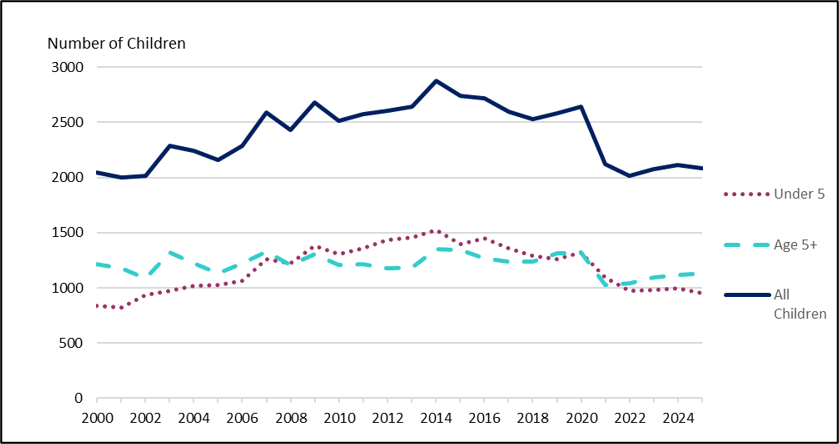
On initial reading of the 2024-2025 statistics, one might come to the conclusion that not much has changed in the data from the year before or, indeed, since 2020-2021. The number of children on the Child Protection Register – 2,083 children on 31 July 2025 – is firmly in line with the number of children for each of the years since the COVID-19 pandemic.
Similarly, domestic abuse (a concern in 44% of children’s registrations on the Child Protection Register in 2024/25), neglect (43%), parental/carer mental ill health (38%), and emotional abuse (32%) all remained the four main concerns leading to a child’s registration on the Child Protection Register.
The apparent lack of change in the data can draw us into a sense of ‘analytical complacency’, where we don’t fully interrogate the data, and we should be wary of this. A key question that still hasn’t been fully resolved, for example, is why the number of children on the Child Protection Register is 20% lower than the pre-COVID-19 pandemic period. An analysis of Figure 1 might suggest that the way in which practitioners and services supported families during the pandemic accelerated the longer-term change within Scotland’s children’s services to more preventative and strengths-based ways of working. If we’re to answer this, we need to consider the statistical data alongside the experience of children, families and practitioners.
At the same time, we also know that many families are experiencing significant pressures with their finances, housing, and their mental health and wellbeing. These pressures can contribute to children being at increased risk of harm, abuse and neglect. Yet, to date, the data might suggest that services have been able to work with and support families so that these circumstances are not leading to more children being placed on the Child Protection Register.
A sense of ‘analytical complacency’ can also mean we do not take into consideration the larger number of children involved in other parts of Scotland’s child protection processes. The fuller picture is that, in 2024-2025, the welfare and concerns of 17,336 children were discussed in child protection inter-agency referral discussions (IRDs), 3,782 children were discussed at initial or pre-birth child protection planning meetings, and 3,023 children were registered on the Child Protection Register. Each of these child protection processes impact on children and their families, and require significant work from social work, police, health, education and third sector workforces.
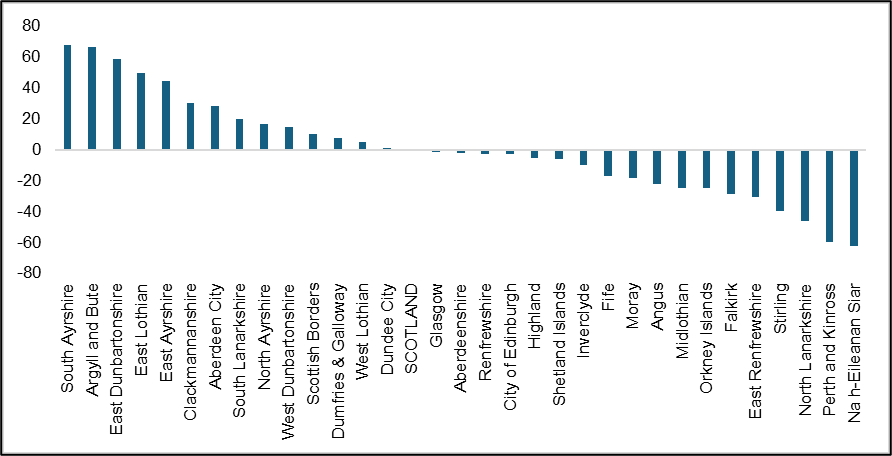
From the national data, it is also possible to think that the apparent lack of change in the aggregate data for Scotland is mirrored across the country. Figure 2 shows the percentage change in the number of children on the Child Protection Register from 31 July 2024 to 31 July 2025. While the Scotland data indicates very little change (2,111 children to 2,087 children represents a 1% reduction), six local authority areas have seen the number of children on their Child Protection Register increase by at least 30%, while five local authority areas have seen the number fall by at least 30%. Particularly where there have been notable changes, it is important that local data and practice colleagues come together to discuss what have been the contributory factors.
The apparent lack of change in Scotland’s child protection statistics in recent years does not, however, mean that national and local data officers are complacent about the data that is being collected. There has been, and continues to be, significant pieces of work to improve Scotland’s understanding of the scale and nature of harm and abuse experienced by children. Two key examples of this are the provision of local child sexual abuse and exploitation data in response to the National Review of Group-Based Child Sexual Abuse and Exploitation, and the development and testing of new disability indicators for inclusion in the national Child Protection Statistical collection from 2026-2027.
Improving our data about child sexual abuse, child sexual exploitation and disability are important developments, but they will not be the only areas where we need to improve Scotland’s child protection data. As a member of the Children's Care and Protection Data Community for Scotland, I believe it is vital that we keep challenging ourselves and working together to continue improving the data we have about children’s lives. Only by more fully understanding the scale and nature of the harm and abuse children experience can we better ensure we have the services and supports in place to prevent future harm.
The views expressed in this blog post are those of the author and may not represent the views or opinions of our funders.
Commenting on the blog posts: sharing comments and perspectives prompted by the posts on this blog are welcome.
CELCIS operates a moderation process so your comment will not go live straight away.